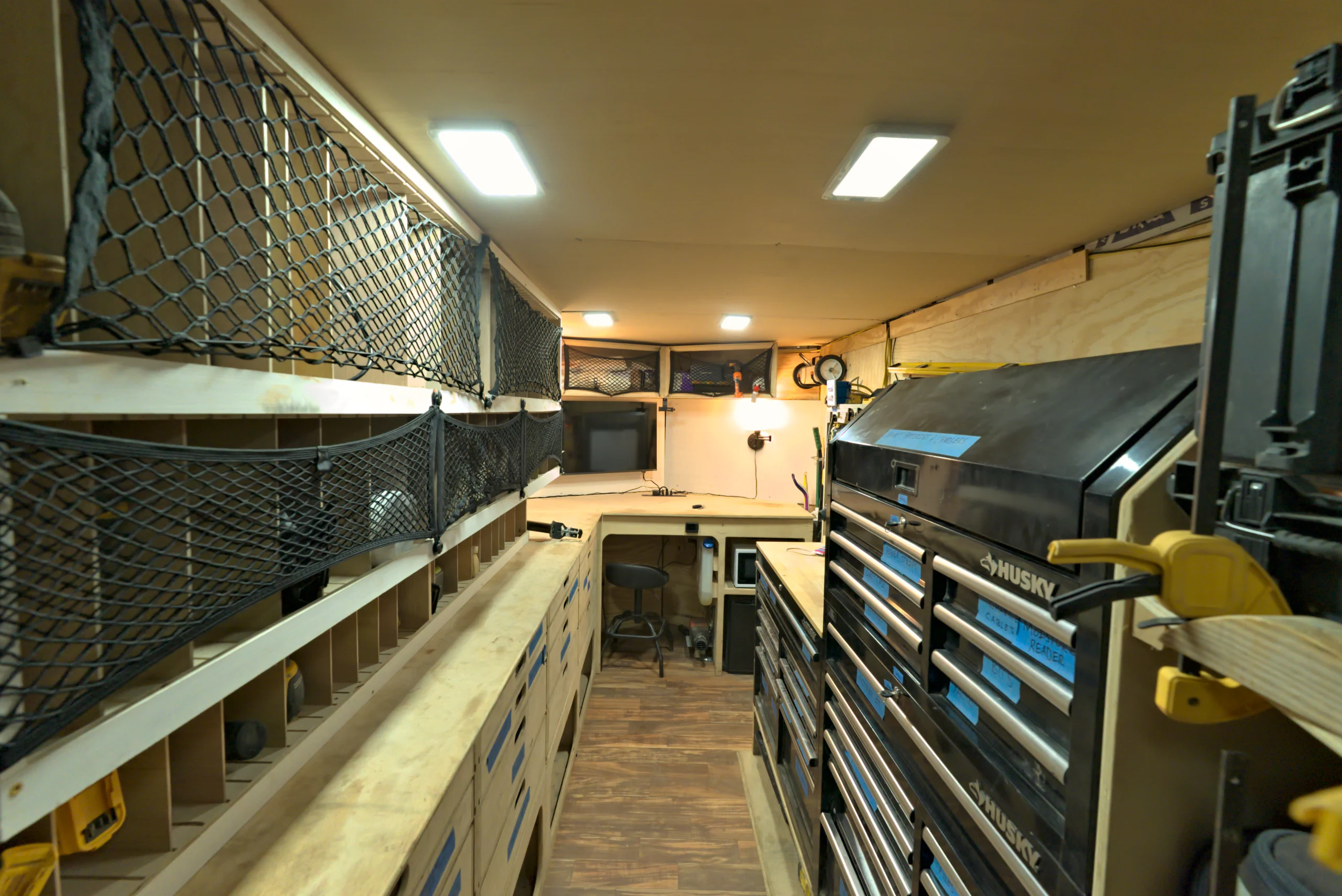
Most enclosed trailers on a jobsite are boxes. Tools go in at night, come out in the morning, and someone spends part of the day digging for whatever ended up at the back. A mobile workshop trailer is an enclosed trailer laid out so the crew can operate from it: pull a tool, use it, put it back where it lives, without unloading the trailer to get started.
We know the difference from the wrong side of it. Scott and Mike ran their residential building work from two trucks and a barn, and most mornings began with roughly 30–60 minutes of loading Packout boxes and truck beds. The trailer they built to stop doing that is our field-used working prototype: a 7×16 V-nose enclosed cargo trailer, still in daily use on our own jobs. It is the running example in this guide. It is a prototype, not a production unit, and nothing here assumes it is the right answer for your crew.
The short definition
A mobile workshop trailer has three things a cargo trailer usually lacks:
- Assigned homes. Every frequently used tool, case and consumable has a place it returns to, so a missing item shows up as an empty spot.
- A working path. A clear aisle and a deliberate entry, so nobody moves three things to reach one.
- Operating zones. Space divided by how the work moves (daily access, heavy or long items, charging, consumables, paperwork), not just by what fits.
Power, lighting, insulation and a desk support those three ideas. Shelves without assigned homes or a usable aisle are still a box.
Operating base vs. cargo box
| Question | Cargo box | Operating base |
|---|---|---|
| What happens on arrival? | Unload what the day might need | Open up and pull what the task needs |
| Where does a tool go after use? | Wherever there is room | Back to its assigned home |
| How do you spot what is missing? | When you need it | Empty spots are visible |
| What happens at day's end? | Repack, protect, drive, unload | Return the last items and close up |
That table describes intent, not a guarantee. A well-organized cargo trailer can work very well, and an operating-base layout still needs a crew that puts things back.
The zones we actually use
The prototype is organized into zones we settled on by using it. They are a reasonable starting framework for any contractor planning a workshop trailer:
- Rear entry and daily access. The ramp drops into a central aisle. Rolling Ridgid cases have their own position: the bottom cases stay stocked with what we use every day, and the top case goes into the house.
- Paulk-style drawer wall. Ron Paulk-inspired plywood drawers hold cordless tools, sanders, tape, bits and small consumables. Each drawer lifts over a small block before it opens, so drawers stay shut on the road without straps.
- Metal drawer bank. Husky tool chests on the other side hold chargers, cords, knives, bits, PPE and fasteners.
- Large tools. The miter saw slides into a dedicated position and the table saw has its own place up top. Levels, squares, clamps, a broom, the shop vacuum, a fan and the first-aid kit have fixed spots.
- Long items. Under-cabinet bays roughly ten feet long, reached from the side, hold levels, dust-containment poles and similar gear.
- Ladders and sawhorses. A ladder slides out of a concealed pull-out bay; sawhorses and a stepladder sit behind the metal drawer bank, out of the aisle.
- V-nose workstation. The front is the place for plans, paperwork, a screen and charging.
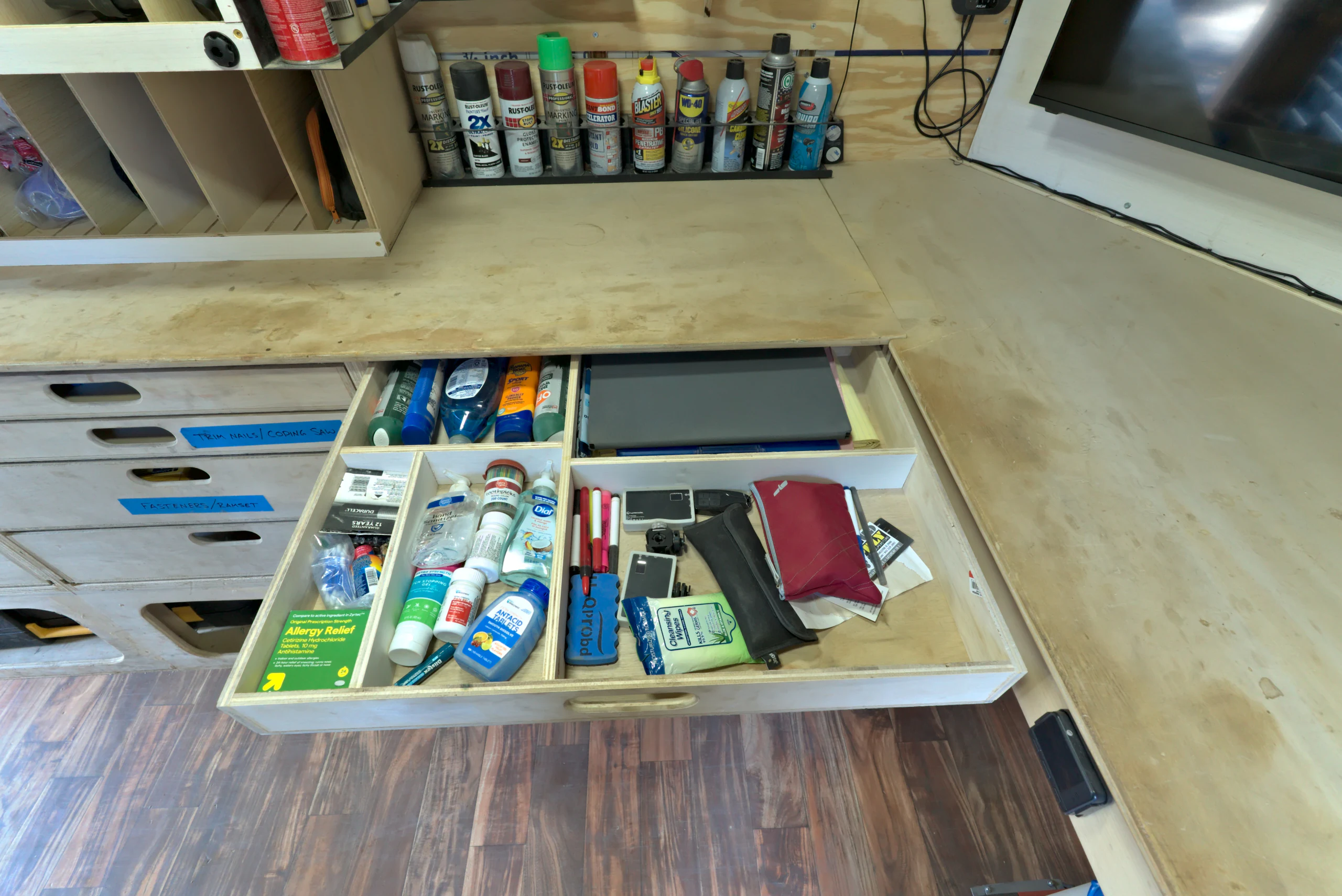
The shelving and layout guide shows how to plan zones like these for your own inventory.
Who tends to benefit
A workshop trailer is most worth evaluating when several of these are true:
- The same core kit follows the crew. Saws, cases, ladders, levels and consumables move job to job, and rebuilding that kit every morning is a recurring cost.
- Jobs last days or weeks. A parked base earns more of its keep on a remodel or new build than on a twenty-minute service call.
- Inventory lives in someone's head. The layout can carry some of that load.
- Store runs for forgotten items are common. Our own early pattern was rebuying lower-cost items because driving home cost more time than replacing them.
- A suitable tow vehicle is already in the operation. That does not prove compatibility, but it makes evaluation practical.
The trade-fit guide goes through builders, remodelers, carpenters and other trades one at a time.
Who may not
A workshop trailer may be the wrong tool if:
- your day is many short stops in dense neighborhoods, where hitching, backing and parking cost more than they save;
- typical jobsites cannot legally or practically fit a trailer;
- nobody on the crew wants to tow and maneuver one;
- your kit is small enough that a well-planned van or truck box already handles it; or
- you would mostly use it as storage.
For those cases, start with the cargo van comparison or the box truck comparison.
Site and tow questions come first
No layout matters if the trailer cannot get to the work. Before choosing drawers, answer these:
- Access. Can it reach, turn around in and leave your typical driveways and lots?
- Parking. Where does it sit during the day, and is that allowed on your usual jobs?
- Tow system. Qualification has to verify the vehicle, hitch, payload, tongue allowance, brake controller and loaded configuration. A truck model name is not an approval.
- Weight. A built-out trailer with a full kit is heavier than an empty one. Final finished and tongue weights will be documented before a binding order; we have not published them.
- Security. Security is a system, not a lock. No trailer eliminates theft risk.
The fit and towing checklist turns these into a worksheet.
Pricing a trailer as a system
Price the platform, interior storage, electrical and lighting, build labor and the cost of owning and towing it. The cost guide breaks those categories down. If you are leaning toward building your own, read DIY vs. a defined system first.
Where Biltout fits
Biltout is Coombs & Co's attempt to turn the trailer we built for ourselves into one standardized 7×16 product. The photographs on this page show the field-used prototype in October 2026, with normal signs of use. The design visualizations elsewhere on the site show the intended production layout. They are not the same thing, and the written offer, not a photograph, confirms what a production Biltout includes.
To see how the prototype came together and what it still does not prove, read the prototype story.
Five questions before choosing any platform
- What leaves the vehicle at nearly every stop, and what stays?
- How long does your crew spend loading, searching and resetting on a normal day? (The calculator on our homepage uses only the numbers you enter; it does not predict savings.)
- How long do your typical jobs last, and could a base stay parked on them?
- Who drives, tows, parks and restocks, every day and not just on good days?
- What would have to be true about your vehicle, sites and crew for a trailer to be a responsible choice?
If the answers point toward a trailer, the fit checklist is next. If they point elsewhere, that is a useful answer too.