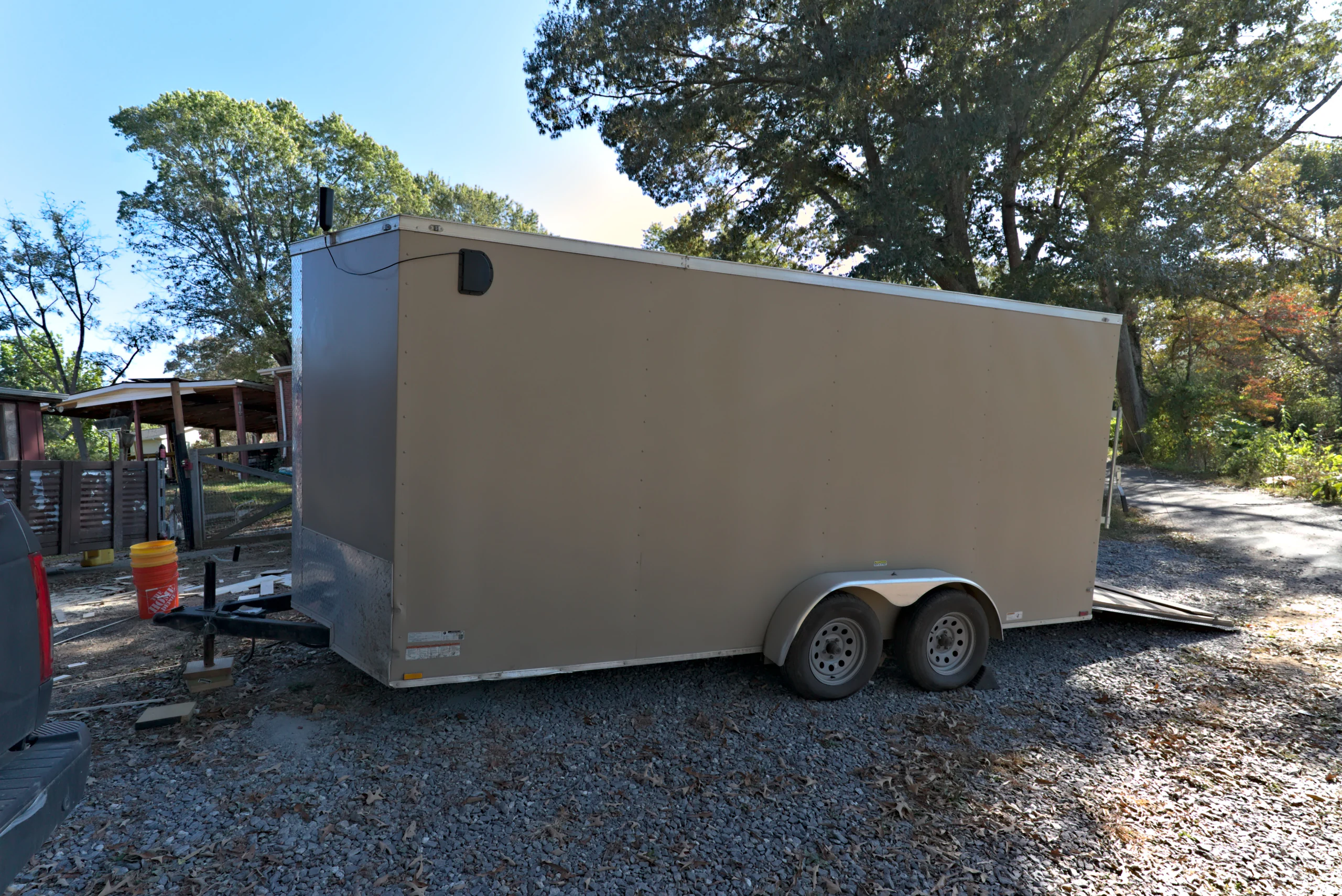
For some contractors a cargo van is the faster, simpler daily vehicle. For others an enclosed trailer is a more useful operating base at the jobsite. Neither is automatically better, cheaper, safer or more productive. It depends on what moves every day, where the crew works, who drives, and what the vehicle and jobsite can support.
We build trailers, so read this with that in mind. We spend as much space on when a van wins as on when a trailer does. Our own path was neither: we ran from two trucks and a barn until we built the field-used trailer that became the Biltout prototype.
Write down a normal week first
- What comes off the vehicle at nearly every stop?
- What must stay accessible while the crew is working?
- Which tools, consumables, ladders, long items, plans and chargers travel daily?
- How often do you work on occupied streets, tight driveways, long renovations or short service calls?
- Who drives, parks, loads, tows and restocks?
A service technician making many short stops has a different problem from a remodeler running a multi-week project. For the first, easy entry and parking may matter most. For the second, rebuilding the same tool base every morning is the cost worth attacking.
When a cargo van fits better
A van deserves the first look when the day depends on fast starts, frequent stops, street parking and one vehicle. Consider one when:
- You make many short stops. Hitching, backing and trailer parking can add more friction than they remove.
- You regularly face tight access. Dense neighborhoods, restricted parking, garages and crowded lots change the math.
- Your equipment package is stable and compact. A planned upfit can keep parts, bins and tools near the right doors.
- One operator moves the whole setup. One vehicle simplifies daily handoffs.
- You do not want a separate tow system. A trailer adds hitch, brake-controller, loaded-configuration, parking and maneuvering questions.
A van is not automatically organized. Map what is carried, secured, reached and charged, and what is left behind when the vehicle runs an errand.
When an enclosed trailer fits better
A trailer can pay off when the crew benefits from leaving a defined operating base at a longer-running jobsite. Look harder at one when:
- The same core system follows the crew. Moving saws, cases, ladders and consumables repeatedly is an organization problem.
- Jobs run long enough for a base to matter. A parked trailer stays put while the truck leaves for supplies.
- You need distinct operating zones. Hand tools, drawers, long items, ladders, rolling equipment, charging and paperwork can be planned separately.
- A tow vehicle is already in the operation. That does not prove compatibility; it only makes evaluation practical.
- Jobsite access and parking are verified. A trailer is wrong if it cannot be legally and practically maneuvered, parked, secured and loaded at typical sites.
What the trailer side looks like in practice
Our prototype is a 7×16 V-nose enclosed trailer in daily use on residential building jobs. Four things a van upfit would have to solve differently:
- The truck can leave. On a multi-week job the trailer stays as the base while the truck goes for materials.
- Long items ride inside. Under-cabinet bays roughly ten feet long hold levels and dust-containment poles, and a ladder slides out of its own concealed bay.
- Saws have fixed homes. The miter saw slides into a dedicated position; the table saw has its own place.
- There is a place for paperwork. The V-nose is set up as a workstation for plans and a screen.
It also brings problems a van does not have: a qualified tow setup, room to park and turn, and someone willing to back it into a driveway.
Compare constraints side by side
| Decision area | Cargo van | Enclosed trailer | Ask before deciding |
|---|---|---|---|
| Daily access | Tools stay with the vehicle; door layout governs use | Ramp and side access can support zones and an aisle | What must be reached first and most often? |
| Parking | Often simpler on tight sites, though size matters | Needs turning, backing, parking and securing space | Can it work at your real jobs? |
| Jobsite base | Leaves when the vehicle leaves | Can remain as a base if site rules allow | Does the crew need the vehicle elsewhere? |
| Storage | Shelves, bins, partitions, racks | Drawers, walls, long-item and rolling-tool zones | What needs protected, vertical or frequent access? |
| Dependency | One vehicle carries the system | An appropriate tow vehicle and setup is required | Who drives, and what if it is unavailable? |
| Ownership | Vehicle and upfit | Trailer, tow vehicle, hitch, brakes and interior | What must be maintained and documented? |
This is not a scorecard. A van can be hard to work from if its layout is an afterthought, and a trailer can be hard if its aisle, restraint, site plan or towing setup is not thought through.
Do not skip towing
Towing is not a model-name shortcut. Qualification should verify the vehicle, hitch, payload, tongue allowance, brake controller and loaded configuration. For any Biltout, final finished and tongue weights will be documented before a binding order; we have not published them. How you load the trailer changes where the weight sits, so test the loaded setup, not an unloaded impression. The fit checklist lists what to gather.
Compare cost categories, not one sticker number
Build a planning sheet that includes the base vehicle or trailer; shelving, drawers, racks and restraint hardware; the electrical and lighting you actually specify; design and installation labor; registration, insurance, maintenance, tires and storage; and, for a trailer, the tow vehicle and hitch setup you would need to add. Add jobsite access, parking and dispatch friction. The cost guide goes through each category.
A six-step decision sequence
- Inventory the workday. List frequent-use tools, long items, rolling equipment, consumables, ladders, paperwork and charging.
- Map constraints. Record driveway, street, site, crew, driver, weather, storage and security questions. No setup eliminates theft risk.
- Draw zones, not just shelves. The layout guide walks through it.
- Test real jobs. Compare a tight-access job, a normal remodel and a longer project.
- Verify the tow system.
- Price the full scope. Ask what is included, excluded, optional and not yet measured.
What Biltout can show today
A field-used prototype with visible zones for daily tools, drawers, charging, long items, ladders, saws and jobsite administration. That is evidence of a real operating idea. It is not proof that every trade should choose a trailer, that any photographed item is included in a production Biltout, or that a buyer will save a stated amount of time or money. Tools shown belong to our crew.
If you are weighing a larger single vehicle, read box truck vs. enclosed trailer. If the trailer path looks promising, ask: what must be true about my work, vehicle, access and operating system for this layout to be a responsible fit? The mobile workshop trailer guide and the fit checklist are built around that question.