Contractors who outgrow a van usually look two ways: a bigger single vehicle, often a box truck, or a tow vehicle pulling an enclosed trailer. Both can be built out as a place to work from. Neither is automatically cheaper, safer or more productive. They differ mainly in what is bolted together and what can separate.
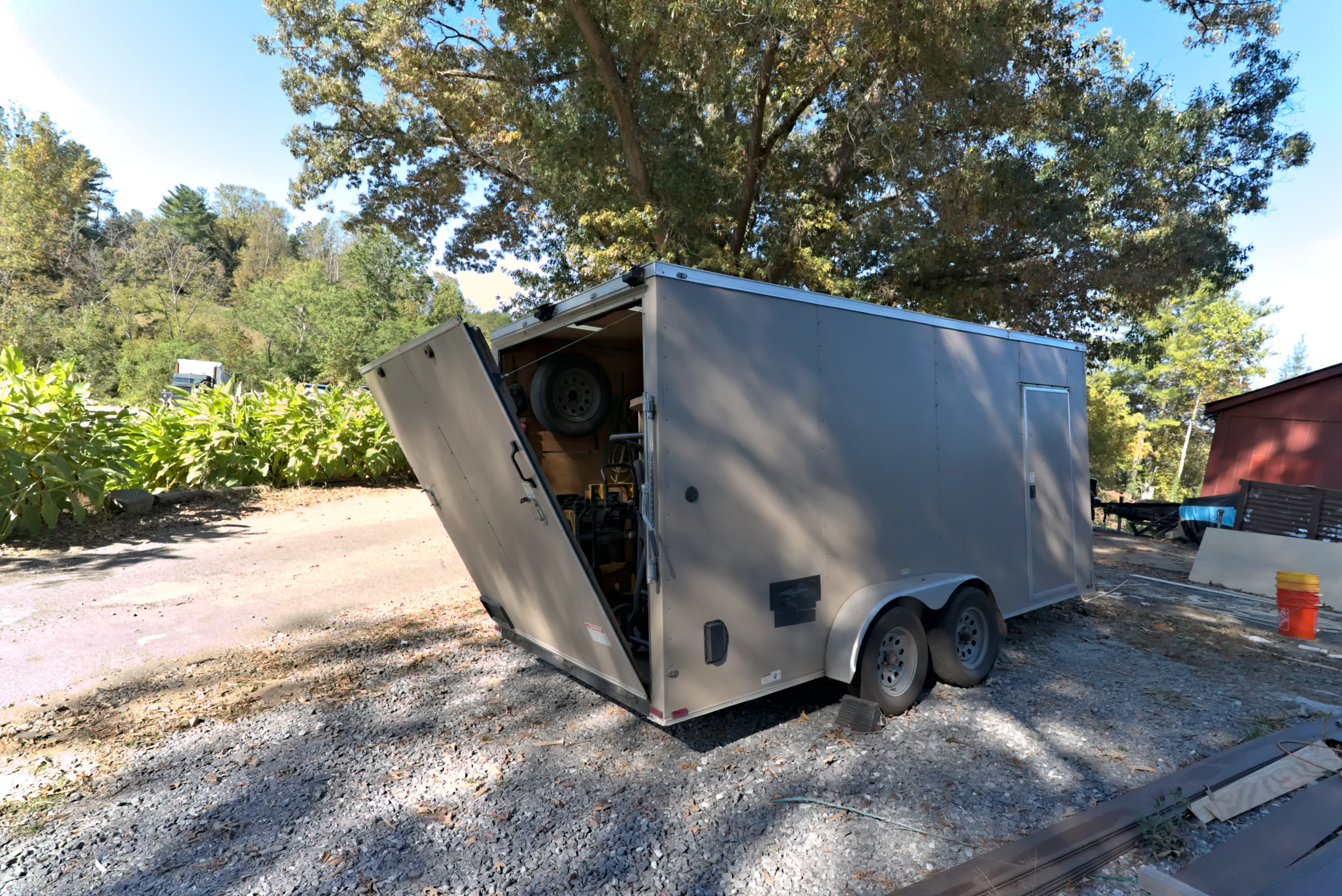
We use an enclosed trailer, the field-used 7×16 V-nose prototype behind Biltout. That gives us direct experience with one side of this comparison and not the other, so we have written the box-truck side as questions rather than claims.
The core difference: one unit or two
A box truck is one machine. The workspace and the engine go everywhere together, and the workspace is out of service when the truck is.
A trailer is two units. The workspace can stay on the jobsite while the tow vehicle leaves for materials, and either can be serviced or replaced without the other. The cost is a qualified tow vehicle, a hitch and brake setup, and someone comfortable towing and backing.
Which matters more depends on your week.
Access and parking
- Turning and backing. A trailer pivots at the hitch, which makes backing a skill. A box truck backs like a truck but may need more room to turn in tight lots. Test both at your real sites if you can.
- Overhead clearance. Taller vehicles and trailers both meet low branches, carports and garages. Measure what you actually drive under.
- Daytime parking. A trailer can be unhitched and left. A truck sits where the workspace is, even when the crew needs it elsewhere.
- Overnight storage. Where does it live when not working, and is that allowed there?
Driver and platform dependence
| Question | Box truck | Enclosed trailer |
|---|---|---|
| Who can drive it? | Check licensing for the vehicle's weight class in your state | Check towing and licensing for the combined vehicle and trailer |
| What if the vehicle is in the shop? | The workspace is in the shop too | Another qualified tow vehicle can pull the trailer |
| Can the crew use the vehicle for errands? | Only by taking the workspace along | Yes, if the trailer can be left on site |
| Does it need a separate tow setup? | No | Yes: vehicle, hitch, payload, tongue allowance, brake controller and loaded configuration all need verifying |
We are not quoting licensing thresholds or weight classes because they vary and change. Confirm current rules for your state and vehicles.
Maintenance and ownership
A box truck brings a drivetrain: engine, transmission, emissions equipment and everything else on a powered vehicle, plus the workspace. A trailer brings axles, bearings, tires, brakes, lights and a coupler, and still relies on a tow vehicle you own and maintain. Neither list is short. Price both before assuming one is simpler.
Workspace
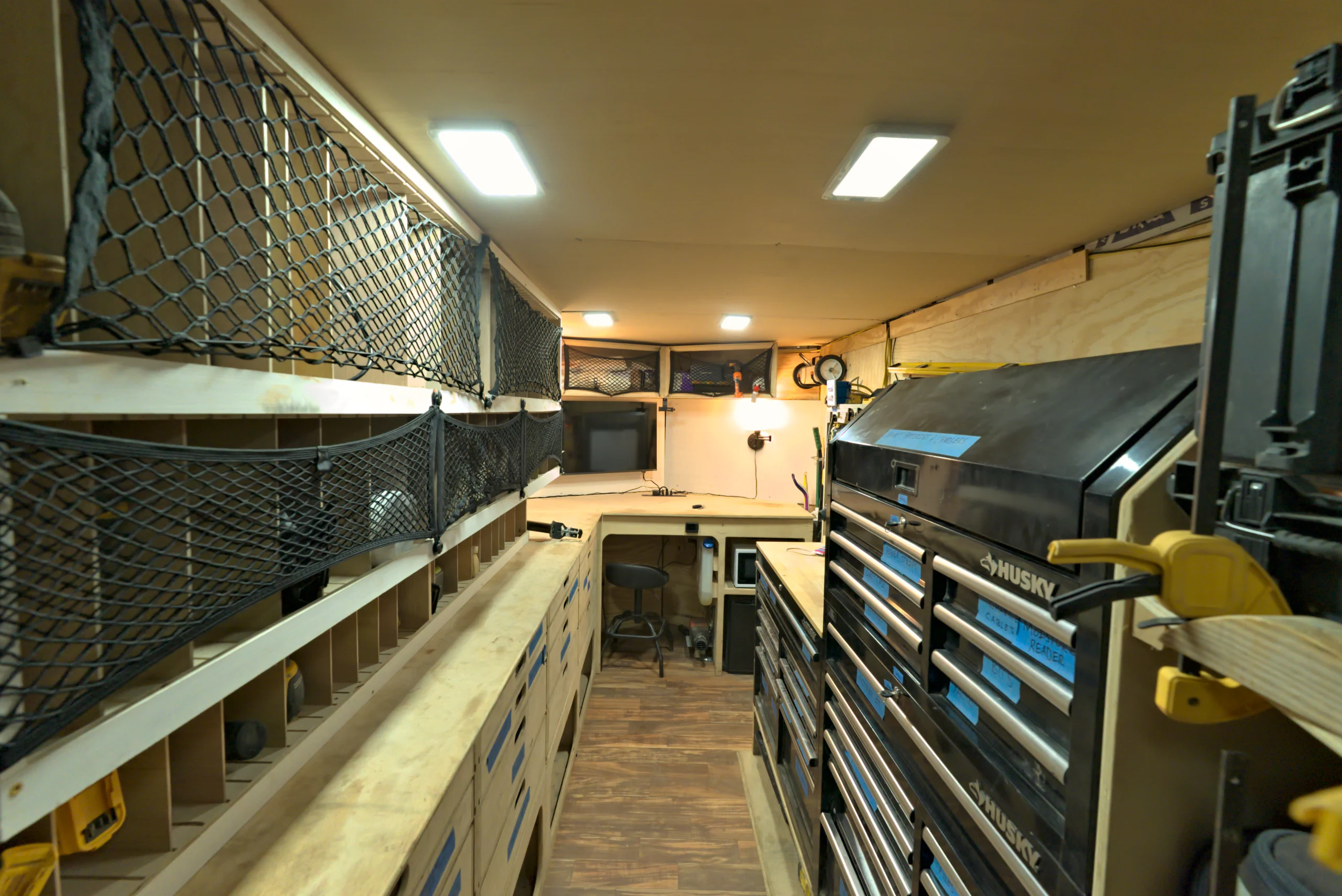
Interior principles are the same either way: assigned homes, a clear aisle, frequency zones and restraint for the road. The layout guide covers them. What differs:
- Entry. Our trailer's rear ramp doubles as a place to roll cases in and out. A box truck may have a liftgate or a high floor; work out how heavy rolling items get in and out.
- Shape. Our V-nose front became a workstation for plans, a screen and charging. A box truck's forward wall is flat.
- Headroom. Both can be insulated and lit; how much headroom you get depends on the specific unit.
Cost categories, not one price
For each option, list the platform (a box truck, or a trailer plus the share of a tow vehicle it depends on); interior storage, finish and restraint; electrical, lighting and charging; build labor or the price of a built-out unit; registration, insurance, inspections and maintenance for every powered and towed unit; fuel and tires; and the cost of downtime when the platform is out of service. The cost guide details each category.
Worksheet: compare your own week
| Constraint | Box truck: works? | Trailer: works? | Notes |
|---|---|---|---|
| Typical driveway / lot access | |||
| Overhead clearance at your sites | |||
| Base needs to stay while vehicle leaves | |||
| Drivers available and licensed | |||
| Tow vehicle already owned and qualified | |||
| Service downtime plan | |||
| Overnight storage | |||
| Rolling and heavy items in/out |
If the trailer column holds up, read cargo van vs. enclosed trailer to pressure-test the other direction, and DIY vs. a defined system before deciding how to build it out.
Where Biltout fits
Biltout is one standardized 7×16 enclosed trailer developed from our field-used prototype. We do not build box trucks and we do not claim a trailer beats one in general. If a trailer fits your constraints, the mobile workshop trailer guide explains how we think about the category, and a conversation is how to find out whether our layout fits your work.