"How much does a work trailer cost?" has no single answer, because two quotes for a "mobile workshop trailer" can describe different things: one an empty cargo trailer with shelves, the other a finished, wired, insulated layout. Break the cost into categories, price each, and compare quotes line by line.
This guide does not quote market prices. Trailer, material and labor costs change with region, supplier, freight and timing, and we have not verified a current market survey we would stand behind. It gives you the categories, the questions, and Biltout's own public price as one fixed reference point.
The categories
1. The trailer platform
The empty enclosed trailer: size, nose shape, door and ramp configuration, axles, brakes, tires and frame. Our prototype starts from a 7×16 V-nose enclosed cargo trailer.
Ask: what are the GVWR and axle rating, what are the empty and finished weights, and who verified them? For Biltout, final finished and tongue weights will be documented before a binding order.
2. Interior and storage
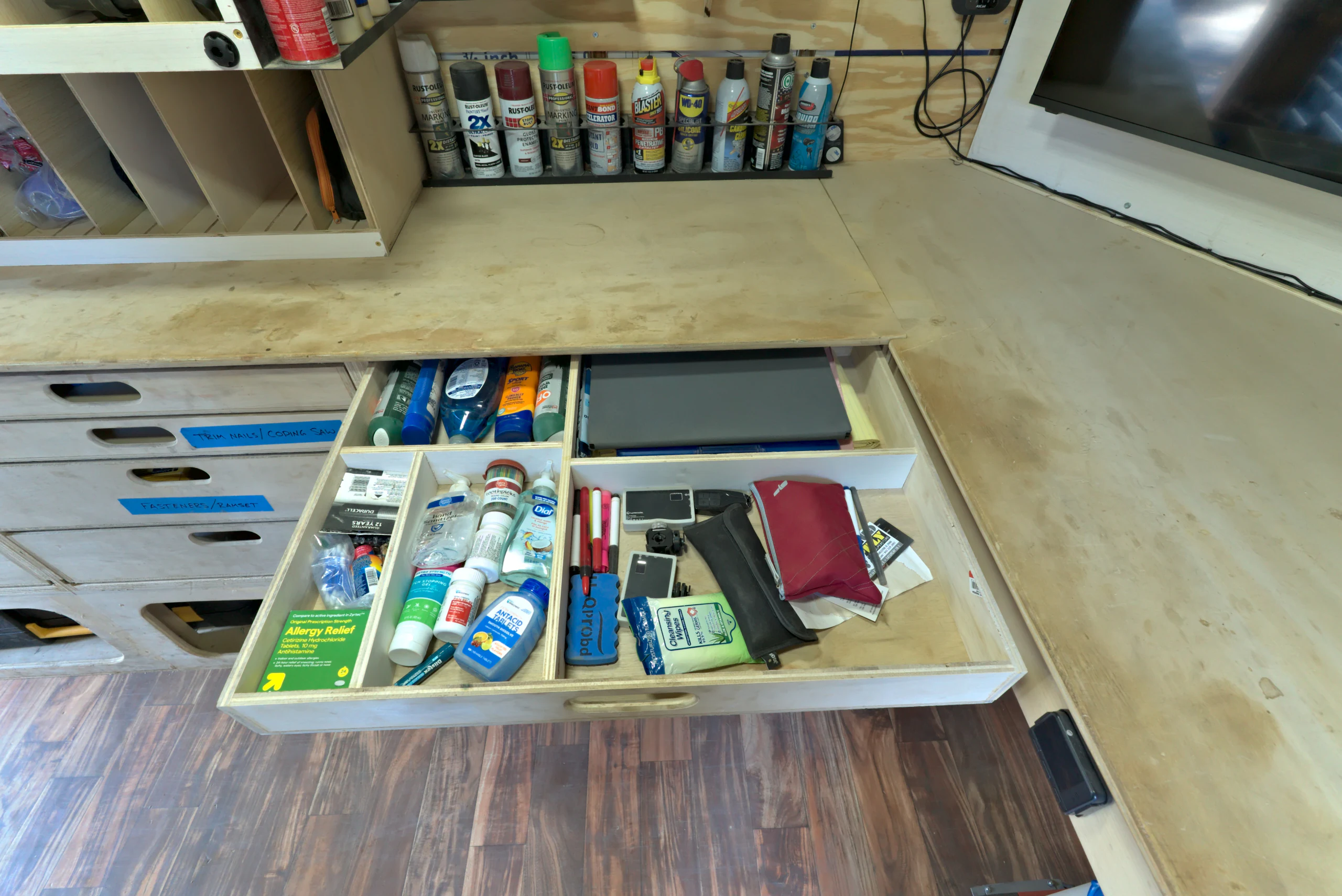
Drawers, cabinets, cubbies, racks, work surfaces, flooring, wall finish, and the hardware that keeps everything shut on the road. DIY budgets often underestimate this: drawer slides, latches and quality sheet goods add up, and so does the time to design them.
Ask: what storage is included, what appears in photos but is not included, and how does each piece stay closed in transit?
3. Insulation, lighting and electrical
Insulation, interior lighting, outlets, charging and shore-power access are the baseline for a workspace you can use year-round. Batteries, inverters, generators and connectivity hardware add capability and cost. Electrical work is also where safety and documentation matter most.
Ask: who designed the electrical system, what are its ratings and limits, and what documentation comes with it?
4. Labor
Design, sourcing, fabrication, electrical install, finish and quality checks. If you build it yourself, this is your time and the work you did not do while building. Our first functional version took three people four days and was still about half done. See DIY vs. a defined system.
5. Freight, tax, title and delivery
Shipping the trailer and materials, sales tax, title and registration, and getting the finished unit to you. These are easy to leave off a comparison.
6. Ownership
Insurance, registration renewals, tires, bearings, brakes, inspections, storage, subscriptions for any connected devices, and generator fuel and maintenance if one is included.
7. The tow vehicle
If you do not already have a vehicle qualified to tow the loaded trailer, with the right hitch, payload, tongue allowance and brake controller, that is part of the trailer decision. See the fit checklist.
What it costs to keep doing what you do now
The other side of the budget is your current cost of friction: time spent loading, searching, resetting and making store runs for forgotten items. The calculator on our homepage puts that cost in dollars using only the numbers you enter. It does not predict what any trailer would save, and we do not claim a payback period.
Biltout's price, as a reference point
Biltout is one standardized 7×16 product with a $36,999 public price. Tools are not included; the tools in our photos belong to our crew. Delivery is quoted separately. Before any binding order, the written offer confirms the final component list, finished weight and capacity, tow review, payment schedule, build timing, delivery quote and warranty terms. The homepage ownership section lists what the price is intended to cover.
No financing program is currently available, and we do not publish payment or savings estimates.
Comparison worksheet
Use one column per option: your DIY plan, a dealer upfit, Biltout, a van or truck alternative.
| Category | Option A | Option B | Option C | Notes |
|---|---|---|---|---|
| Platform | ||||
| Interior and storage | ||||
| Insulation, lighting, electrical | ||||
| Labor (yours or theirs) | ||||
| Freight, tax, title, delivery | ||||
| Ownership, per year | ||||
| Tow vehicle and hitch setup | ||||
| Excluded but needed | ||||
| Total |
Pre-quote checklist
Bring these questions to any quote, including ours:
- What exactly is included, and what is shown in imagery but excluded?
- Which items are finished, and which are planned or optional?
- What are the measured empty, finished and tongue weights?
- What are the electrical ratings, and who designed the system?
- How is everything restrained for travel?
- Who is responsible for delivery, title and registration?
- What warranty and service terms are in writing?
- What is the payment schedule, and when is the order binding?
A quote that cannot answer these is not necessarily wrong, but it is not finished. If you are still choosing a platform, compare the cargo van guide and the mobile workshop trailer guide.