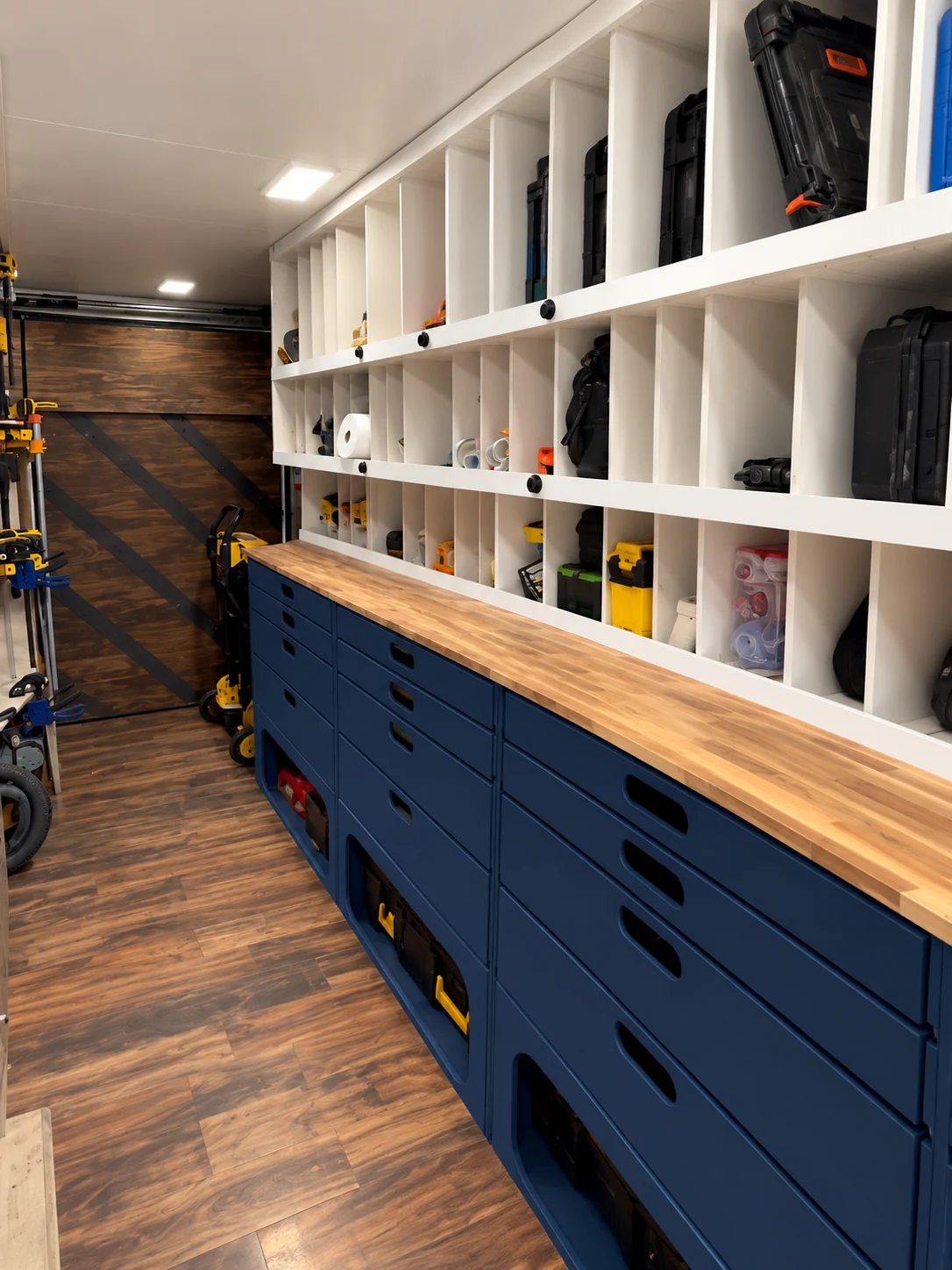
The trade on your truck matters less than the shape of your workday. Two electricians can have opposite answers: one runs short service calls all over town, the other spends six weeks wiring a new house. So this guide starts with the variables that decide fit, then splits trades into two groups: the ones where we have first-hand evidence from our own trailer, and the ones where we only have good questions.
The five variables that decide fit
| Variable | Trailer tends to fit better | Trailer tends to fit worse |
|---|---|---|
| Job duration | Days to weeks on one site | Many short stops per day |
| Kit size and shape | Large, varied kit with saws, long items and ladders | Small parts and a compact tool set |
| Site access | Driveways and lots with room to park and turn | Dense streets, tight garages, restricted lots |
| Crew | Two or more people pulling from the same kit | One person who never leaves the vehicle |
| Tow setup | A qualified tow vehicle already in the operation | No tow vehicle, or no one comfortable towing |
No one variable is decisive. Count how many land on the left for your normal week, not your best one.
Where we have first-hand evidence
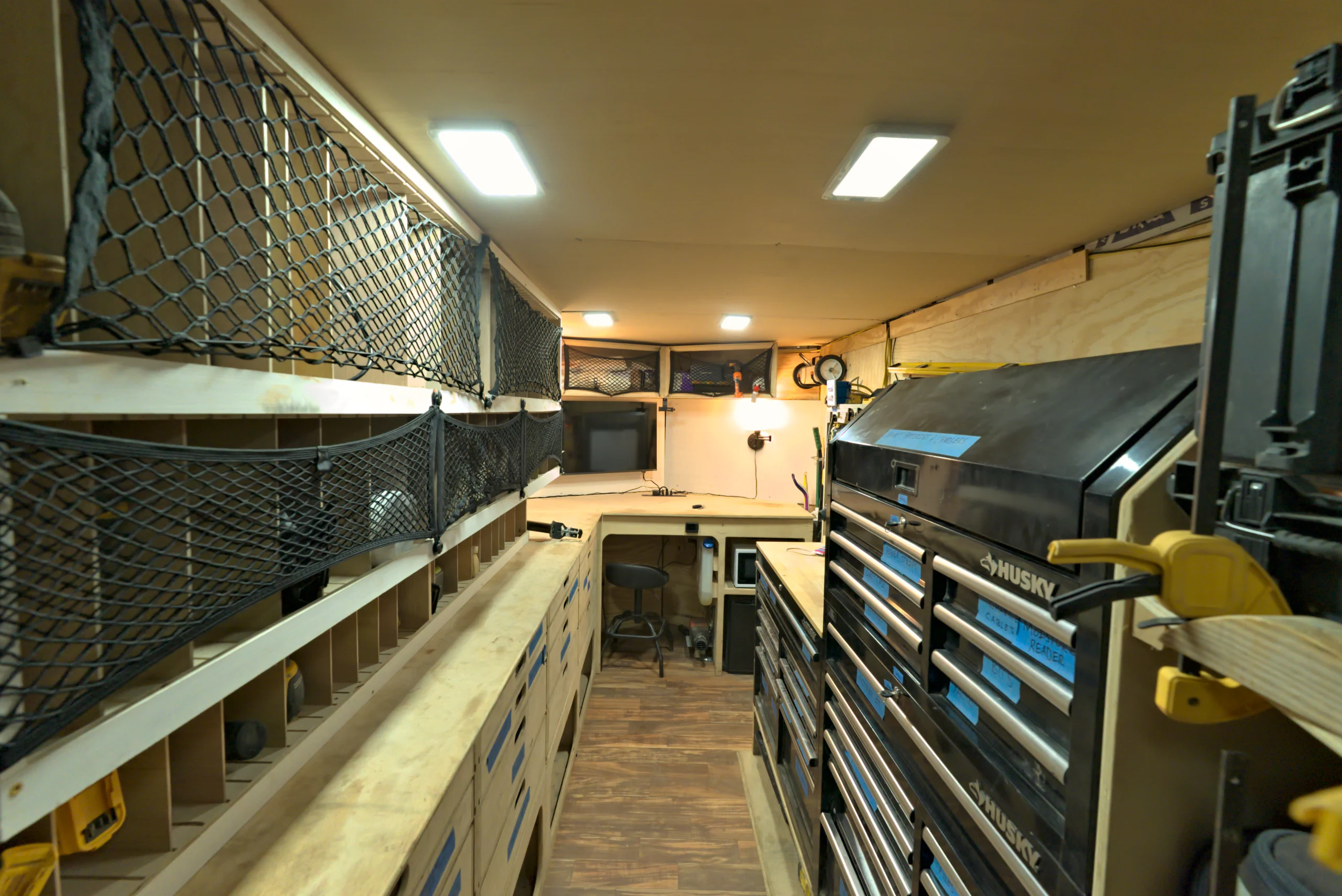
Our working prototype is a 7×16 V-nose enclosed trailer built and used by residential builders, on our own jobs every working day. We can speak to these trades from use, while being clear that it is a prototype and our experience is one crew's.
Residential builders and general contractors
This is the use we built it for. A small residential builder carries the widest mix: carpentry, drywall, masonry and finish tools, ladders, work surfaces and a lot of consumables. What mattered most to us:
- labeled consumables, so running out is visible before it costs a store run;
- long-item storage for levels and dust-containment poles;
- a place for plans and paperwork, so management work can happen on site; and
- a base that can stay parked on a multi-week job.
Remodelers
Remodeling occupied homes adds two pressures: keeping the client's house clean and keeping dusty work contained. Our trailer carries the extendable poles we use to hang plastic in a dedicated long bay, and the shop vacuum has a fixed home. The main layout question for remodelers is separating clean daily access from dirty, awkward gear.
The trade-off: remodels in dense neighborhoods may leave no room for a trailer. Check typical sites before you assume it will fit.
Carpenters and trim crews
Carpentry is where a workshop trailer is easiest to picture. Our miter saw slides into a dedicated position, the table saw has its own place, and clamps, levels and squares hang where they can be grabbed. The open question for a carpentry crew is where cutting happens (inside, on the ramp or outside) and what that means for dust, lighting and weather.
Trades where we only have questions
We have not used our trailer as electricians, plumbers or HVAC contractors, and we will not pretend otherwise. These trades may fit well, or a van may be the better tool.
Electricians
- Is your week mostly rough-in on new construction and remodels, or service calls?
- Is your kit dominated by wire, boxes and small parts, or by tools?
- Do wire spools, conduit or long stock need to travel, and where would they ride?
- Would a crew working one site for days benefit from a parked base?
Plumbers
- How much of your kit is fittings and small parts that want bins instead of drawers?
- Do you carry pipe stock long enough to need dedicated long-item storage?
- Does water, mud or sewage exposure change what can go back into the trailer?
- How many stops a day is a typical week?
HVAC and other service trades
- Do you install on multi-day jobs, or service across many short calls?
- Do refrigerant tanks, recovery equipment or ductwork travel, and what transport rules apply to them?
- Would the trailer stay at one site, or move several times a day?
If your answers describe short stops, small parts and one person, read the cargo van comparison. If they describe longer jobs, a larger kit and a crew, the layout guide is next.
When a van, truck or job box wins
A trailer is probably not your best answer when:
- your work is mostly short service calls in tight access areas;
- your kit fits comfortably in a well-planned van or truck box;
- nobody wants to own the towing, parking and maintenance; or
- you would use the trailer as storage rather than a place to work from.
A note on Biltout and trades
Biltout is one standardized 7×16 product. The trade examples above describe how different crews might use a layout like it; they do not change the product, and we do not claim it fits every trade. If your trade is not covered, your own numbers are the best evidence: measure your current friction, work through the fit checklist, then start a conversation and tell us how your day runs. For the broader picture, see the mobile workshop trailer guide.